

 |

|
|
 |
|
Feature Archive |
 |
||||||||||||||||||||||||||||||
| By Trisha Ginsburg | ||||||||||||||||||||||||||||||
|
"No picnic will ever be the same."
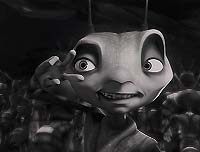
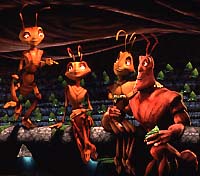
So say the advertisements for the new movie Antz. But one could say the same for computer-generated feature films. Antz is the second completely computer-generated (CG) full-length feature film to hit the screens. Silicon Graphics systems were there during every step of the production process, from rendering and animating to file serving and storage. It took 166 desktop systems, 270 servers, and approximately 160 people to create the film. "Origin2000 servers and O2 desktop systems worked extremely well for us," said Mark Kirk, systems architect at Pacific Data Images (PDI). "The Origin2000 has a lot of bandwidth and was able to scale and grow with our production. We like the O2 systems for their nice price point and onboard video capabilities. It was helpful for people to be able to watch dailies of the film at their desks." Added Ed Granlund, a production supervisor on the film, "We constantly were looking at ways to improve our throughput and utilization. Whenever desktop machines were not in use by animators, our system was designed to utilize the processor for rendering. We rendered around the clock, peaking at over 600 processors, counting all the Origin 2000 systems, renderfarm machines, and desktop machines. We also became very clever about how we utilized disk space and served data. Our supervising technical directors George Bruder and Mitch Amino relentlessly fine-tuned the pipeline for maximum efficiency and creative control". Was PDI satisfied with using an all-Silicon Graphics solution? "The results are in the film," said Patty Bonfilio, one of the Antz production managers at PDI. "It's stunning." The real-life graphics are largely a result of PDI's in-house proprietary software, developed on Silicon Graphics machines. Antz contains over 760 special effects, ranging from footfall dust and magnifying glass reflections to smoke, fire, and water. The film breaks new ground in such traditionally challenging areas as facial animation, crowd sequences, and water simulation effects. If facial animation is a difficult task in the most simplistic CG film, imagine animating Woody Allen's eyebrow expressions using a computer system. In Antz, Allen brings his well-known neurotic shtick to the voice of the lead ant, Z. "Our facial animation system afforded us the ability to have the character speak a line of dialogue, and have the facial expressions send an entirely different message," said Granlund. "The subtleties of the character's expressions make them appear almost real." In the past, facial expressions were accomplished by using "morph targets"--prebuilding certain expressions and segueing between them--or by applying surface muscles that manipulated only the top skin. PDI's new facial animation system, created by Dick Walsh, incorporates a sophisticated, anatomically based structure that corresponds to the actual bone, muscles, fat, and skin of the human face. "The great thing about the facial animation system is that it's based on human anatomy and the way that the human face works with all of its components: bones, tissues of varying thicknesses, and muscles that pull and have a relationship to other muscles," said Ken Pearce, director of research and development for PDI. "We can also add additional controls for extreme, cartoony expressions on top of the realistic controls, and these can be blended in to the extent you want. We can fit the system to faces of different proportions, so we're able to take these ants, which are proportionately extremely different from human heads--especially the eyebrows--and really get evocative, human-like performances out of them." Now imagine animating the expressions of an entire ant colony. "If you have a film about ants, it would be disappointing to never have a shot with more than five ants. You want 5,000--or maybe 50,000 ants to convey the sense of a colony to the audience," said Kirk. "With our crowd system, the directors and animators have a great amount of creative control, yet there's a tremendous labor savings. They're able to define the way a crowd will look, move, and behave, and then let the computers calculate the specific motion for each ant in the crowd." A crowd scene constitutes any shot that has too many characters to keyframe by hand. In Antz, there are over 500 shots with crowd scenes, ranging from a handful of ants to over 60,000 in an underground colony. The animators had to be able to control the background characters with almost the same flexibility they had with the main characters, yet be able to manipulate them by the thousands when required. The Crowd Animation System was developed at PDI by Luca Prasso and coauthored by Juan Buhler and Jonathon Gibbs. It consists of two systems in one: the Crowd Simulator and the Blending System. The Crowd Simulator is used to produce realistic motion for thousands of characters at a time. The Blending System was designed to simplify the work of animators who had to create and assign individual actions to one character in a crowd. "Four or five years ago, if you'd gone to anybody in computer effects and animation and said that you wanted to do a film that has thousands and thousands of extras, and you have to generate them with unique motion and unique angles, they'd have told you to jump off a bridge," said Antz coproducer Brad Lewis. "In Antz, you see multitudes of ants do everything from marching to fighting to dancing." And swimming. Any child who has drowned multitudes of ants with the garden hose knows how dangerous water can be for the microscopic mites. In computer animated films, water has traditionally been an extremely difficult image to convey. With PDI's proprietary software tools, developed by Nick Foster, audiences see startlingly realistic water in the movie's climax. To achieve that effect, millions of digital water particles were rendered for each frame of film, creating the dramatic photo-realistic illusion of real water. "It's a system that creates crashing, splashing, swirling water," said Pearce. "It lets animators get in there and do tricks with it to get the look they want and to get the water to behave according to the wishes of the directors." The film was exciting for PDI because it broke new ground creatively as well as technologically. "What was amazing about the process is that it gave us total creative freedom," Bonfilio said. "The director's vision was first reproduced using traditional artists tools; paper, colored pencils, and the like. We were then able to translate those images into beautifully rendered 3D imagery. What does the inside of an ant colony look like? No one has ever seen one. What does the outside world look and feel like to an ant? A tire track would look like the Grand Canyon. A leaf, like a huge tent canopy." With such stunning realism in this computer-generated film, one might wonder where CG technology will take audiences next. "Computers are still an incredibly untapped resource for artistic expression, and computer animation as a genre has only just begun to be explored on the big screen," said director Eric Darnell. "We're not trying to duplicate reality or to copy traditional two-dimensional animation. The computer permits the characters and the camera to move in three-dimensional space, which allows the viewer to be drawn in the story that much more." No picnic will be the same after Antz. Nor will computer-generated feature films. |
"Origin2000 servers and O2 desktop systems worked extremely well for us...The Origin2000 has a lot of bandwidth and was able to scale and grow with our production."
Mark Kirk,
More info:
by Chuck Lenatti, Upside magazine, 09/08/98
|
|||||||||||||||||||||||||||||
| Images courtesy Pacific Data Images © 1998. All rights reserved. | ||||||||||||||||||||||||||||||
| | | feedback | |
| Copyright © 1998 Silicon Graphics, Inc. All rights reserved. | | | Trademark Information |